
Leave a confidential document on a shared printer for five minutes and anyone walking past can pick it up. No password, no ID check, nothing stopping them. That’s the exact problem secure printing was built to solve, and it’s why so many UK offices are switching it on.
If you print payroll data, client files, medical records or anything else you wouldn’t want left face-up in a communal tray, this guide covers what secure printing actually does, how it works day to day, and what to look for when choosing a printer that supports it.
How Secure Printing Actually Works
Instead of sending a document straight to the paper tray, a secure print job gets held back. It sits encrypted in a queue, either on the printer’s own hard drive or on a print server, and it waits there until someone proves they’re the person who sent it.
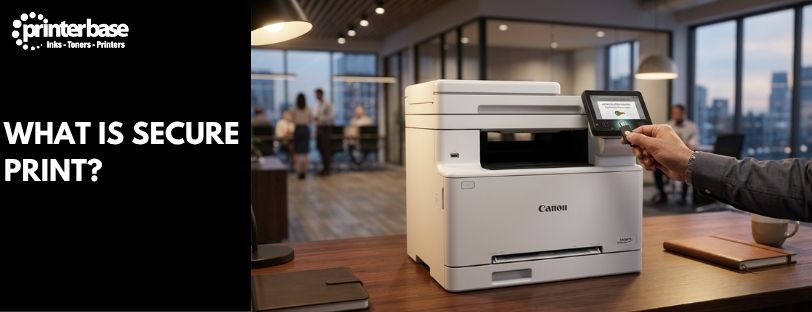
That proof usually happens at the printer itself. You walk up, authenticate, and only then does the job release. Depending on the device and the software behind it, authentication might mean typing a PIN, tapping an ID card, holding a phone against an NFC reader, or scanning a fingerprint. Some setups add a second layer, such as a password on top of a card tap, for anything particularly sensitive.
Jobs that never get collected don’t just sit there indefinitely. Most systems delete unclaimed documents automatically after a set time, so nothing lingers in memory waiting to be found.
Why This Matters More Than Most Businesses Realise
Print security tends to get overlooked because a printer doesn’t feel like a security risk in the way a laptop or a server does. It should. A modern office MFP is a networked computer with a hard drive, and it’s often the least protected device in the building.
A few reasons this ends up costing businesses:
- Unattended printouts. HR letters, invoices, contracts and medical notes sitting in an open tray are fair game for anyone in the building, including visitors and cleaning staff.
- Internal misuse. Not every breach comes from outside. Restricting who can print what reduces both accidental exposure and deliberate snooping.
- Regulatory exposure. UK GDPR and the Data Protection Act 2018 apply to printed documents just as much as digital ones. Firms in legal, healthcare, finance and education carry extra obligations here.
- Network vulnerability. Connected printers can be a way into your network if they’re left on default settings. Xerox has pointed out that modern printers are as sophisticated, and as exploitable, as ordinary computers.
Secure Print vs Pull Printing: What’s The Difference
These two terms get used interchangeably, but they’re not quite the same thing. Pull printing is about convenience: you send a job once and can release it from any printer on the network, wherever you happen to be standing. Secure printing is about control: nobody gets the document without proving who they are first.
In practice, most modern print management systems combine the two. You get the flexibility of picking up your job at any device, plus the authentication step that keeps it out of the wrong hands.
| Feature | Secure Print | Pull Printing (Follow-Me Printing) |
|---|---|---|
| Authentication Required | Yes, always, before release | Not always, depends on setup |
| Main Purpose | Confidentiality and compliance | Convenience and reduced waste |
| Where You Can Print | Usually a fixed device or group | Any authorised printer on the network |
| Best Suited To | Sensitive or regulated documents | General office printing |
Authentication Methods Explained
Not every business needs the same level of authentication. Here’s what’s typically on offer, roughly in order of how much friction it adds:
- PIN or password. The simplest option. You key in a code at the printer’s control panel before your job appears.
- ID, RFID or proximity card. Staff already carrying a building access card can usually reuse it to release print jobs, no extra device needed.
- NFC “tap to print”. A smartphone or NFC-enabled card is held against a reader on the printer. Read more about what NFC printing is and how it works.
- Biometric authentication. Fingerprint or facial recognition, generally reserved for higher-security environments given the extra hardware cost.
- Print management software login. Users sign into a portal or app, which can also enforce quotas, cost centres and double-sided printing rules.
Key Security Features To Look For When Choosing A Secure Printer
If you’re buying new hardware with security in mind, these are the features worth checking on the spec sheet:
- Secure release printing. Non-negotiable. Confirm it’s built in, not an expensive add-on.
- Data encryption. Look for SSL/TLS and IPsec support, so data is protected both in transit and while it’s stored on the device.
- Image overwrite. Some manufacturers wipe the hard drive using a multi-pass algorithm after each job, similar to digital shredding.
- Network authentication. Features like 802.1x and IP filtering stop unauthorised devices connecting to the printer in the first place.
- Removable hard drives. Useful for organisations under strict compliance rules, since the drive can be physically secured or destroyed separately from the printer.
- Audit trails. A log of who printed what, when and from which device, useful for compliance reporting and for spotting misuse.
- Role-based permissions. Restrict scanning, colour printing or high-volume jobs to specific users or departments.
Which Industries Need Secure Printing Most
Any business handling confidential data benefits from secure printing, but a few sectors treat it as close to mandatory:
- Legal firms, where client confidentiality is a professional obligation, not just good practice.
- Healthcare providers, who handle patient records covered by strict data protection rules.
- Financial services, where account details and transaction records carry heavy regulatory weight.
- Education, covering exam papers, safeguarding records and GDPR obligations around pupil data.
- Any HR department, regardless of industry, given the volume of personal data that passes through payroll, contracts and disciplinary records.
Setting Up Secure Printing In Your Office
Rolling it out doesn’t have to be complicated. A sensible starting point looks like this:
- Turn on secure release printing across every device that supports it, not just the ones in obviously sensitive areas.
- Pick an authentication method staff will actually use. Card readers tend to see better adoption than PIN codes, since there’s nothing to forget.
- Encrypt data both to the printer and on it, not just one or the other.
- Set unclaimed jobs to expire automatically, ideally within a few hours.
- Add print management software if you need reporting, cost tracking or department-level rules.
- Brief staff on why the change is happening. Adoption drops fast if people see it as an inconvenience rather than a safeguard.
Printers With Secure Print Built In
Most major manufacturers now build some form of secure release into their business printers, though the exact name and feature set varies. Brother’s Secure Print+ releases jobs using a PIN code or NFC card with no extra software to install. Xerox devices combine secure print release with encryption, image overwrite and network authentication as standard on business-grade models. Konica Minolta’s bizhub SECURE lets you configure authentication and access rules per device. HP, Canon, Kyocera and Epson all offer comparable secure release options across their office ranges too.
If you’re not sure which of these fits your setup, our team can talk you through the options for your office.
Frequently Asked Questions
What Is Secure Printing?
Secure printing holds a print job in an encrypted queue until the person who sent it authenticates at the printer, usually with a PIN, card or NFC device. It stops confidential documents sitting unattended in an output tray.
How Is Secure Printing Different From Pull Printing?
Pull printing lets you release a job from any printer on the network for convenience. Secure printing adds a mandatory authentication step so the document only prints once the right person is standing at the device. Many systems now offer both together.
Do I Need Special Software For Secure Print?
Not always. Some printers, such as Brother models with Secure Print+, handle it with built-in firmware and a PIN or NFC card, no extra software required. Larger deployments with reporting, quotas or multi-device management generally do use dedicated print management software.
Can Secure Printing Save My Business Money?
Yes. A large share of office printing is never collected. Once jobs expire automatically instead of printing regardless, wasted paper and toner drop noticeably, and quota-based systems make it easier to see where costs are coming from.
Is Secure Printing A GDPR Requirement?
UK GDPR doesn’t name secure printing specifically, but it does require appropriate technical measures to protect personal data, and printed documents fall within that scope. For businesses handling personal or sensitive data, secure printing is a straightforward way to demonstrate compliance.
What Happens To An Unclaimed Print Job?
Most secure print systems delete unclaimed jobs automatically after a set period, often a few hours, rather than leaving them stored indefinitely or letting them print unattended.
Which Printer Brands Offer Secure Print As Standard?
Brother, Xerox, HP, Canon, Kyocera and Konica Minolta all include some form of secure release printing on their business printer ranges, though the authentication options and depth of features vary by model.
Need Help or More Information ?
If you’d like help choosing a printer with the right security features for your office, get in touch with our team. Visit our Contact Us page, call us on 0161 308 5800, or use Live Chat on our main website.