
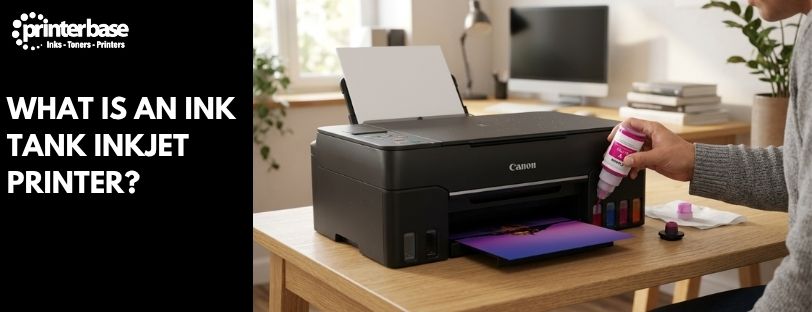
Buying ink cartridges every few weeks gets expensive fast, and that is exactly the problem ink tank printers were built to solve. Instead of swapping in a new cartridge every time the ink runs low, you top up a set of built-in tanks from cheap refill bottles, and one fill can keep you printing for months rather than weeks. Epson, Canon, Brother and HP have all built their own version of the technology, and it has become one of the most popular printer categories for households and small businesses that print regularly.
This guide covers how ink tank printers actually work, and where they beat cartridge and laser printers on running costs, reliability and lifespan.
How Does An Ink Tank Printer Work?
A standard inkjet printer stores each colour in a small, sealed cartridge. Once that cartridge runs dry, you throw it away and click in a new one. An ink tank printer replaces those cartridges with larger tanks built into the printer body, connected directly to the print head. This setup is often called a continuous ink supply system, or CISS.
Refilling one is straightforward. You open the tank cover, remove the bottle’s seal, and rest the bottle upside down on the tank’s coloured nozzle. Most designs stop automatically once the tank reaches its fill line, so there is little risk of overfilling or spilling ink everywhere. Every tank has a transparent window built into the printer’s casing, so you can see exactly how much ink is left without opening the machine or guessing from a warning light.
The print head itself works the same way as any inkjet: microscopic nozzles fire precise droplets of ink onto the page. The difference is entirely in how that ink gets to the print head, and how much of it is sitting there ready to use.
Ink Tank Vs Cartridge Vs Laser Printers
Here is how the three main printer types stack up against each other, covering the areas that matter most day to day.
| Feature | Ink Tank Printer | Cartridge Inkjet Printer | Laser Printer |
|---|---|---|---|
| Upfront Cost | Higher | Lower | Mid to high |
| Cost Per Page | Very low | High | Low for text, higher for colour |
| Refill Method | Ink bottles into built-in tanks | Snap-in cartridges | Toner cartridges |
| Typical Yield Per Fill | Thousands of pages | 150 to 700 pages per cartridge | Thousands of pages per toner |
| Photo And Colour Quality | Excellent | Good to excellent | Limited on photo paper |
| Best For | Frequent home and small business printing | Occasional, light use | High-volume text and office documents |
| Plastic Waste | Low, refillable bottles | Higher, disposable cartridges | Moderate, toner cartridges and drums |
Why Ink Tank Printers Cost Less To Run
This is the main reason people switch. A full set of tanks on most ink tank printers is rated to print several thousand pages of black text before you need to refill, compared with somewhere between 150 and 700 pages from a typical ink cartridge. Because the bottles cost far less per millilitre than the equivalent cartridge, your cost per page drops to a fraction of a penny for black text and stays well below cartridge pricing for colour and photos too.
Laser printers can undercut ink tank machines slightly on plain black text, since toner covers a huge number of pages per cartridge. However, most laser printers charge considerably more per page once you print in colour, and few handle photo paper well at all. If your printing is a genuine mix of documents, colour graphics and the odd photo, an ink tank printer usually works out cheaper overall than either alternative.
Are Ink Tank Printers Reliable?
Cartridge inkjets have one well-known weakness: leave them unused for a few weeks and the ink inside the small cartridge can dry out, clogging the print head and forcing a cleaning cycle that wastes even more ink. Ink tank printers are far less prone to this. The sealed reservoirs hold a much larger volume of ink, the tubing keeps a steady supply flowing to the print head, and the whole system is built to sit idle between print jobs without drying up.
That reliability extends to the printer’s overall lifespan too. Because you are not constantly opening the case to swap cartridges, there is less wear on the mechanism, and a well-maintained ink tank printer can comfortably last years of regular home or office use. Ink bottles and the odd printer-head cleaning cycle are usually all the maintenance these machines need.
Things To Consider Before Buying An Ink Tank Printer
Ink tank printers are not the right choice for everyone, so it is worth checking a few things before you buy.
Initial cost. Ink tank models cost more upfront than a basic cartridge printer, with entry-level machines typically starting from around £140. You make that money back through lower running costs, but it does mean a bigger outlay on day one.
Print speed. Budget ink tank printers often print somewhere in the region of 10 to 15 pages per minute. That is fine for home use, homework, or a small office, but it may feel slow if you regularly print long documents in bulk.
Refilling. Topping up a tank takes a couple of minutes and rarely spills if you follow the fill line, but it is still a slightly more hands-on job than clicking in a cartridge. Stick to genuine ink bottles for the printer’s warranty and to avoid print quality issues. If you already own an Epson model, our guide to refilling an Epson EcoTank printer walks through the exact steps.
Features you actually need. Many ink tank printers come as all-in-one units with scanning, copying and an automatic document feeder, and most support Wi-Fi or wireless printing from a phone or laptop. Check the specific model covers what you need before assuming every ink tank printer is the same.
Conclusion
Ink tank printers solve the one thing that makes cartridge printers so irritating: running out of ink at the worst possible moment and paying through the nose to fix it. Once you have covered the higher price at the till, every page after that costs a fraction of what a cartridge printer charges, and a single set of full tanks can keep you printing for months. They hold up well over time too, since the sealed tanks and steady ink flow put far less strain on the print head than cartridges that dry out between uses.
Laser printers still make sense if you print thousands of black and white pages and rarely touch colour. For anyone who prints photos, colour documents, or a genuine mix of both, an ink tank machine usually wins on running costs without giving up on print quality. If you print more than the occasional letter or homework sheet, the extra you pay upfront is normally worth it within the first year.
Frequently Asked Questions
What Is An Ink Tank Printer?
An ink tank printer is an inkjet printer with large, refillable ink tanks built into the printer body instead of small disposable cartridges. You top the tanks up from ink bottles, and one fill typically lasts for thousands of pages.
How Is An Ink Tank Printer Different From A Cartridge Inkjet Printer?
Both use the same inkjet print head technology, spraying tiny droplets of ink onto the page. The difference is how the ink is stored and replaced. Cartridge printers use small, disposable cartridges that need replacing every few hundred pages, while ink tank printers use much larger refillable tanks topped up from bottles.
Are Ink Tank Printers Cheaper To Run Than Laser Printers?
For colour and photo printing, yes, ink tank printers are usually cheaper per page than laser printers. For plain black text only, a laser printer’s toner can sometimes edge ahead on cost per page, but ink tank printers tend to win overall once you factor in colour printing and the lower upfront cost of entry-level models.
How Often Do You Need To Refill An Ink Tank Printer?
It depends on how much you print, but most ink tank printers are rated to print several thousand pages of black text, or hundreds of pages of colour and photos, from a single full set of tanks. Light home users can go many months between refills.
Do Ink Tank Printers Produce Good Quality Prints?
Yes. Ink tank printers use the same print head technology as standard inkjets, so text, colour graphics and photos all come out sharp. Some models are specifically built for photo printing, so check the specification if photo quality is a priority.
Are Ink Tank Printers Worth The Higher Upfront Cost?
For most households and small businesses that print regularly, yes. The extra you pay when buying the printer is typically recovered within the first year through lower ink costs, and you keep saving every year after that. If you only print a handful of pages a month, the savings take longer to add up and a standard cartridge printer might suit you better.
Which Brands Make Ink Tank Printers?
Epson (EcoTank), Canon (MegaTank and PIXMA G Series), Brother (Ink Tank range) and HP (Smart Tank) all make ink tank printers, ranging from budget single-function models to full all-in-one machines with scanning, copying and automatic document feeders.
Need Help or More Information ?
If you need any further help or more information, reach out to us by leaving a comment below or through one of the many ways on our Contact Us page.
Alternatively you can contact us by Phone on 0161 308 5800 or by Live Chat on our main Website Monday to Friday and our team will be happy to help or answer with any questions you might have.
You can also find all the various ways to connect with Us at the bottom of this page. Please share this post if you found it helpful.