
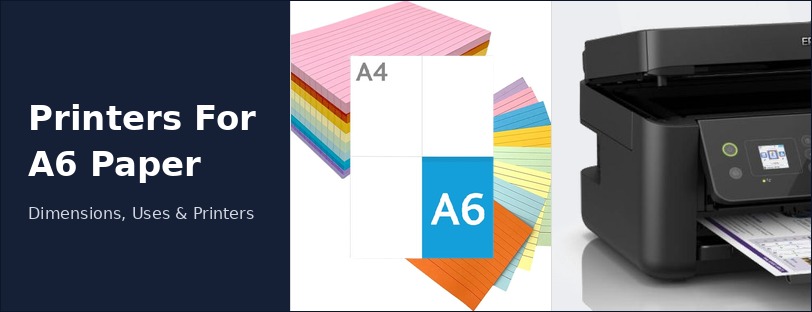
A6 paper measures 105 x 148mm, roughly the size of a postcard, and it’s the size behind flyers, invitations, notepads and plenty of till receipts. Most printers can handle it too, even though it rarely shows up as a default option in the paper settings menu. This post covers the exact dimensions, the right paper weight for different projects, what A6 gets used for, printers capable if printing A6, and how to get your printer set up to print on it.
Which Printers Print On A6 Paper?
Most printers can print on A6, even though it’s rarely listed as a headline spec. A6 support usually comes down to two things: whether the printer’s driver includes A6 in its list of paper sizes, and whether the paper tray or feed mechanism can grip a sheet that small without jamming.
Photo printers and compact inkjets tend to handle A6 particularly well, since many are built around printing photos and postcards in the first place. Larger office laser printers can usually manage it too, though you may need to feed A6 sheets through a manual or multi-purpose tray rather than the main paper cassette, which is designed around A4. If you print A6 jobs regularly, it’s worth checking the spec sheet for a stated minimum paper size before you buy. We’ve also covered printers that handle card stock well, which is worth a read if you’re printing anything heavier than standard paper.
How Do I Print In A6?
In terms of actually printing in A6, you may need to take on a couple of steps which is dependent on the printer you have, software you’re using etc.
Some people tend to print onto A4 size media having just designed or written what they need in A6 size in the programme they’re using. For example, if in Microsoft Word, you would go to – File > Page Setup > then click the paper margin and select A6 in size. This should format your document to the A6 size.
If printing directly onto A6 media, you would still do the above but you’d need to amend your printer settings to accommodate this. Depending on the printer you have, you would insert an A6 sheet and adjust the sheet holders and/or you would then adjust the print size within your printer settings.
There are two ways to get an A6 print, depending on whether you’re using actual A6 sheets or printing onto A4 paper.
Printing A6 Content Onto A4 Paper
Design or write your document at A6 size within your software, then print it onto standard A4 paper. In Microsoft Word, go to Layout > Size and select A6 from the list, or use File > Print and choose A6 under paper size if your printer driver supports it. You’ll need to trim the sheet down afterwards, or print four A6 pages per A4 sheet if your software supports multi-page layouts.
Printing Directly Onto A6 Media
Load actual A6 sheets into your printer’s tray, adjusting the paper guides so they grip the smaller sheet securely. Open your printer’s driver settings and set the paper size to A6 before printing, rather than leaving it on the default A4. Some printers need A6 media fed through a specific manual or rear tray rather than the main cassette, so check your printer’s manual if the standard tray won’t accept it.
If you’re not sure your printer supports A6 at all, the quickest way to check is a test print. Load a single sheet, set A6 in both your document and your printer driver, and print one page before committing to a full run.
For additional help, refer to your printers user manual or speaking the printer manufacturer’s support team.
Looking to print in different media such as card or card stock? Read our blog post dedicated this.
A6 Paper Dimensions
A6 paper measures 105 x 148mm (10.5 x 14.8cm, or 4.1 x 5.8 inches). It’s part of the ISO 216 A-series, the international paper standard where each size is exactly half the area of the one before it. A6 is half the size of A5 and a quarter of A4, which is why four A6 sheets fit perfectly onto one A4 sheet with no wasted margin.
If you’re designing an A6 file digitally rather than printing straight from a document, the pixel dimensions depend on the resolution you’re working at. At 300dpi, a full-bleed A6 canvas comes out at roughly 1240 x 1748 pixels, which is the standard you’d use for anything going to a commercial printer.
| Size | Dimensions (mm) | Dimensions (inches) | Relation To A6 |
|---|---|---|---|
| A4 | 210 x 297mm | 8.3 x 11.7in | 4x the size of A6 |
| A5 | 148 x 210mm | 5.8 x 8.3in | 2x the size of A6 |
| A6 | 105 x 148mm | 4.1 x 5.8in | — |
| A7 | 74 x 105mm | 2.9 x 4.1in | Half the size of A6 |
A6 Paper Weight (GSM)
GSM stands for grams per square metre, and it’s the measurement that tells you how thick and sturdy a sheet of paper is. The right GSM for A6 depends entirely on what you’re printing.
- Standard documents and notepads: 80-100gsm is fine, the same weight as everyday printer paper.
- Flyers and leaflets: 120-170gsm holds up better when handed out or posted through a letterbox without feeling flimsy.
- Postcards and invitations: 250-300gsm card stock is standard, since these need to survive the post or being handled repeatedly.
- Greeting cards: 300-350gsm gives a stiffer, more premium feel if you’re printing cards to fold and send.
Heavier stock isn’t always better. A 300gsm sheet feels great for a postcard but will jam a home inkjet that isn’t rated to feed card, so check your printer’s maximum supported GSM before loading anything thicker than standard paper. For more on paper weights, types and sizes, see our Complete Guide To Printer Paper.
What Is A6 Paper Used For?
A6’s compact size makes it a popular choice wherever something needs to be small enough to hold, post or slot into a display stand. Common uses include:
- Postcards – A6 is close enough to the standard postcard size that it’s the default choice for most postal postcard runs.
- Flyers and leaflets – cheap to print in bulk and easy to hand out or leave on a counter.
- Invitations and greeting cards – a practical size for weddings, parties and other events.
- Notepads and jotters – small enough to keep on a desk without taking up much space.
- Menus and price lists – a common size for takeaway menus and in-store price cards.
- Small brochures and booklets – several A6 pages stapled or folded together for event guides or product catalogues.
The Verdict
A6 paper is one of the most practical sizes in printing precisely because it’s so unassuming: at 105 x 148mm, it’s small enough to post, carry or slot into a stand, but big enough to hold a proper headline, image and call to action. So, which printers print on A6 paper? In practice, most modern printers can, but how well they handle it varies. Photo printers and compact inkjets are usually the safest bet, since many are built around postcard and photo printing in the first place, while office laser printers can generally manage A6 too, just often through a manual or multi-purpose tray rather than the main cassette, which is set up for A4.
The right choice comes down to two things – pick a GSM that suits the job (light 80-100gsm for notepads, heavier 250-300gsm card for anything posted or handled repeatedly), and check your printer can feed sheets that small, since most struggle less with printing A6 itself than with actually gripping the paper. For occasional use, printing four-up on A4 and trimming down works fine; for regular runs, a printer with confirmed A6 support and a manual feed tray will save time and paper. If you’re buying with A6 printing in mind, our A6 Printer Range is a good place to start, as every model listed there is confirmed to handle the size properly.
A6 Paper FAQ
Do All Printers Support A6 Paper?
No. While most modern printers can technically print at A6 size, not all can physically feed a sheet that small – older or budget models are more likely to jam or reject it. Always check the printer’s spec sheet or driver settings for A6 before buying if you print this size regularly.
What Type Of Printer Is Best For A6 Printing?
Photo printers and compact inkjets tend to be the most reliable choice, since many are designed around postcard and photo-size printing already. If you need a higher-volume or office setup, look for a laser printer with a manual or multi-purpose tray, as these handle small sheets better than the main paper cassette.
Why Won’t My Printer Accept A6 Paper?
This is usually down to one of two things: A6 isn’t listed as an available size in your printer’s driver settings, or the paper tray’s guides can’t grip a sheet that small without misfeeding. Check the driver first, then try loading a single A6 sheet through a manual or rear-feed tray if your printer has one.
Can I Print A6 On A Standard Home Printer?
In most cases, yes. Check your printer’s supported paper sizes in the driver settings, and make sure the paper tray can grip a sheet as small as 105 x 148mm without jamming.
What Size Is A6 Paper In MM?
A6 paper measures 105 x 148mm. In centimetres that’s 10.5 x 14.8cm, and in inches it’s 4.1 x 5.8in.
Is A6 The Same Size As A Postcard?
A6 is close enough to standard postcard dimensions that the two are often used interchangeably. It’s why most postcard printing runs default to A6.
How Many A6 Sheets Fit On One A4 Sheet?
Four. A4 is exactly four times the area of A6, so four A6 sheets can be cut from a single A4 sheet with no waste.
What’s The Difference Between A5 And A6?
A5 is exactly twice the size of A6. A5 measures 148 x 210mm, while A6 measures 105 x 148mm, making A5 better suited to booklets and notepads that need more space, and A6 better suited to postcards and flyers.
What GSM Should I Use For A6 Postcards?
250-300gsm is standard for postcards, giving them enough rigidity to survive the post and repeated handling without bending.
Need Help or More Information ?
If you have any questions about A6 printing or need help choosing the right printer, get in touch with our team via our Contact Us page, call us on 0161 308 5800, or use Live Chat during business hours.
