
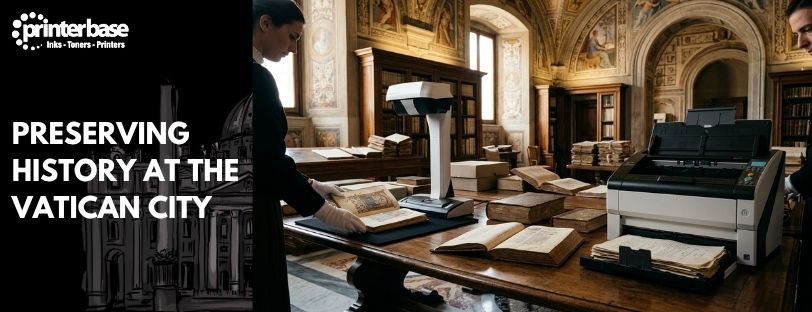
Keeping a centuries-old manuscript safe and getting it in front of the people who need it are two jobs that usually pull in opposite directions. Vatican City’s Dicastery for Communication had to do both. To manage it, the team turned to the Ricoh ScanSnap SV600 and the Ricoh fi-7900.
The Dicastery looks after rare bound volumes, ageing manuscripts and one-of-a-kind photographs. Its job is to get the Pope’s messages and official positions to the world accurately, and that depends on the primary sources staying intact. Scanning that material without damaging it is the hard part.
The result is a searchable digital archive, faster delivery of official material to global media and a lower risk of misinformation. Below, we look at how the two scanners made that possible and what other archives can take from it. You can read the full case study here: Vatican City, Dicastery for Communication
Why Historical Document Preservation Matters
Libraries, museums, universities and public archives all face the same squeeze. Their collections of printed records, manuscripts, photographs and bound volumes keep growing, and every one of them is getting older.
Two goals sit in tension. You want to protect fragile originals from damage, yet researchers, journalists and staff still need quick access to what is inside them. Handling, light and age wear paper down, and each time someone turns a page the risk goes up.
Digitisation offers a way through. A high-quality digital copy can be searched, shared and stored without anyone touching the original again. For the Dicastery, that meant preservation and access could finally happen together rather than one at the expense of the other.
The Challenge: Digitising Rare Books, Manuscripts And Photographs
The Vatican’s archive holds an unusual mix of material. Some of it is bound, some is loose, and almost all of it is irreplaceable.
- Rare bound books and volumes
- Ageing historical manuscripts
- Archival photographs and one-of-a-kind images
- Historical documents that form the basis of accurate reporting
An ordinary sheet-fed scanner is a poor fit here. It pulls paper through rollers, and a bound book cannot go through that process without being taken apart. Even a flatbed can put stress on a spine.
The Dicastery therefore set out five clear requirements: non-contact scanning for fragile originals, high-resolution image reproduction, processing power for large volumes, stability for extended operation, and secure, dependable performance in a protected environment. In short, it wanted a long-term operational foundation rather than a one-off scanning tool.
Why The ScanSnap SV600 Suited Fragile Documents
The ScanSnap SV600 is an overhead scanner. It captures each page from above, so nothing has to be pressed flat, fed through rollers or unbound.
That matters for the Vatican’s collection. The SV600 scans bound materials in high definition with no physical stress on the original, which lowers the risk of wear and damage on volumes that cannot be replaced. Delicate manuscripts and archival images go under the scanner, get captured and go straight back into storage.
The same approach suits any book, journal, newspaper or bound record. If you want to know more about scanning books this way, our guide to the best scanner for books covers the SV600 in more detail.
How The Ricoh fi-7900 Handles Large-Scale Digitisation
Not everything in an archive is fragile or bound. Much of it is loose paper in large quantities, and scanning that by hand under an overhead unit would take far too long.
That is where the Ricoh fi-7900 comes in. It is a production scanner built for high-volume capture, so it works through big batches of documents quickly and reliably. According to the case study, it keeps operational speed up while still delivering archival-quality output.
Together, the two scanners cover both ends of the collection. The table below shows how the work splits between them.
| Scanner | Scanner Type | Role In The Vatican Project |
|---|---|---|
| ScanSnap SV600 | Overhead, non-contact | Digitises bound volumes, manuscripts and fragile originals in high definition without physical stress |
| Ricoh fi-7900 | Production scanner | Processes large volumes of documents quickly and reliably with archival-quality output |
The Results: From Paper Archives To A Searchable Digital Resource
The Dicastery has moved from paper-centred storage to a digitally structured archive. The case study lists five outcomes.
A Searchable, High-Quality Digital Archive
Staff no longer depend on physical storage alone. They can search a structured digital collection instead of hunting through shelves.
Faster Delivery To Global Media
Official materials now reach media organisations around the world more quickly, which matters when the Dicastery’s whole purpose is to communicate accurately and on time.
Accelerated Verification And Less Misinformation
Reliable source documents are easier to find, so historical statements can be checked faster. That in turn reduces the risk of misinformation.
Cross-Functional Use Of Photographic Archives
Digital photographs can be used by more than one team, rather than sitting in a single physical collection.
Several years after implementation, both scanners still run reliably. For a project built around long-term stability, that is the result that counts.
What Comes Next: Photographs, ELO And AI-Powered Search
The project is far from finished. A digitisation programme covering the entire library is now under way, including several thousand photographs. Eventually, a selection of these images will appear on the website, opening up material the public cannot see today.
The Dicastery also plans to use the ELO ECM Suite, an enterprise document and content management platform from ELO Digital Office. Combined with Retrieval-Augmented Generation (RAG) technology, it should support advanced archiving and AI-powered search. To feed that system, the team intends to scan photographs at 600 dpi.
In practice, this means the scanners are only the first step. Good scans create the raw material that search and retrieval tools depend on.
What Other Organisations Can Learn From This Project
Few organisations manage an archive on the Vatican’s scale. Plenty face the same problem, though.
- Universities preserving research collections
- Museums digitising historical records
- Local authorities managing public archives
- Legal firms storing case files
- Libraries protecting rare books
- Government departments preserving official records
The lesson is that one scanner rarely fits a whole collection. Pairing a specialist non-contact scanner with a high-volume production scanner lets you protect what is fragile and still move quickly through the rest. If you are weighing up options for your own project, our guide to choosing a document scanner is a useful starting point, and our post on digitising documents with ScanSnap shows the same idea on a smaller scale.
You can also browse the wider Ricoh scanner range or the Ricoh small business and ScanSnap scanners.
Conclusion
The Vatican project shows that preserving history and improving access do not have to compete. By pairing the ScanSnap SV600 with the Ricoh fi-7900, the Dicastery for Communication protected fragile books, manuscripts and photographs while building a digital archive that staff can search and share.
The SV600 handles anything too delicate to touch, and the fi-7900 carries the volume. Neither scanner has to do a job it was not built for, and that split is the main reason the setup has run reliably for several years.
The same thinking applies well beyond Rome. If you look after rare books, historical records or a large paper backlog, start by working out which of your documents are fragile and which are simply numerous. Then match a scanner to each group. Our team can help you choose, so browse the Ricoh scanner range or get in touch to talk through your project.
Frequently Asked Questions
What Is A Non-Contact Document Scanner?
A non-contact scanner captures a document from above without pressing it flat or feeding it through rollers. That makes it ideal for fragile books, manuscripts and archives.
Why Is The ScanSnap SV600 Suitable For Historical Documents?
The SV600 scans bound and delicate materials without disbinding them or putting stress on the pages. You get a high-quality digital copy while the original stays safe.
What Is The Ricoh fi-7900 Used For?
The fi-7900 is a production document scanner designed for high-volume capture. It suits large-scale digitisation projects where speed and reliability matter.
Why Did The Vatican Use Two Different Scanners?
Its collection includes both fragile bound items and large volumes of documents. The SV600 covers the delicate material, while the fi-7900 handles the bulk work.
What Are The Benefits Of Archive Digitisation?
Digitisation makes records easier to search and share. It also reduces handling of the originals and supports long-term preservation.
Can A Digitised Archive Support AI-Powered Search?
Yes. The Dicastery plans to combine the ELO ECM Suite with Retrieval-Augmented Generation technology. Good-quality scans, such as photographs captured at 600 dpi, give that kind of system better material to work with.
Need Help or More Information ?
If you need any further help or more information, reach out to us by leaving a comment below or through one of the many ways on our Contact Us page.
Alternatively you can contact us by Phone on 0161 308 5800 or by Live Chat on our main Website Monday to Friday and our team will be happy to help or answer with any questions you might have.
You can also find all the various ways to connect with Us at the bottom of this page. Please share this post if you found it helpful.